Teaching Middle School Science with Phenomena
Teaching Middle School Science with Phenomena
Have you ever spent 15 minutes explaining a science concept that you thought was incredibly interesting, only to look up and realize half your students were mentally planning what they're having for lunch?
I've been there. I tell my students I feel like the character Snoopy. I am talking away and all they are hearing is BLAH BLAH BLAH…..
The truth is, most middle schoolers don't wake up wondering about thermal energy, chemical reactions, or density. But they do get curious when something unexpected happens right in front of them.
That's one of the reasons I love using phenomena in my classroom.
Instead of starting with notes or vocabulary, students start with something they can observe. They see it happen, ask questions, make predictions, and try to figure out what's going on. Suddenly they're invested because they want answers.
So What Is a Phenomenon?
A phenomenon is simply something students observe that makes them ask, "Wait...why did that happen?"
It doesn't have to be complicated.
Maybe students watch food coloring spread much faster in hot water than cold water.
Maybe they see black ink separate into multiple colors during chromatography.
Maybe they notice a balloon sticking to a wall after rubbing it on their hair.
The phenomenon comes first. The science explanation comes later.
That small shift changes everything.
Instead of telling students what they need to know, we're giving them a reason to want to know it.
Why NGSS* Focuses So Much on Phenomena
One thing I appreciate about NGSS* is that it moves away from memorizing random facts and pushes students to think like scientists.
Scientists don't start with a worksheet.
They start with observations. They notice something interesting, ask questions, gather evidence, and develop explanations.
That's exactly what phenomena help students do.
Rather than memorizing that heat transfers from warmer objects to cooler objects, students observe it happening and use evidence to explain what they saw.
For middle school students, this approach is especially powerful because abstract concepts can be difficult to grasp. When students can actually see a phenomenon happening, the science becomes much more concrete and meaningful.
What Phenomena Stations Look Like in My Classroom
One of my favorite ways to incorporate phenomena is through stations.
Students rotate through short activities where they observe something interesting, record what they notice, and answer a question that gets them thinking deeper about the science behind it.
Some stations might involve:
• Watching food coloring move through hot and cold water
• Separating colors from black marker using chromatography
• Mixing baking soda and vinegar and observing the reaction
• Testing how many pennies a piece of paper can hold
What I love most is listening to the conversations that happen naturally.
Students start discussion or even debate. They make predictions. They disagree with each other. They try to explain what they're seeing.
And all of that happens before I've even started direct instruction.
The stations become the hook that makes students want to learn more.
Another bonus? They're incredibly flexible. You can run all of them in one day, spread them across multiple class periods, or simply choose the ones that fit your current unit.
The Best Part? You Don't Need Expensive Materials
I think one reason teachers hesitate to do more hands-on science is because they assume it requires a huge budget.
In reality, some of my students' favorite activities have used the simplest materials.
Baking soda
Vinegar
Food coloring
Coffee filters
Balloons
Plastic bags
Paper
Many of the most engaging phenomena can be created using supplies from the dollar store or materials you probably already have sitting in your classroom cabinets.
In fact, one of the stations my students talk about every year is a simple chromatography activity using black marker and coffee filters. They're always amazed when they discover that black ink isn't actually just black.
Those "Wait...what?!" moments are exactly what make phenomena so powerful.
A Ready-to-Go Option
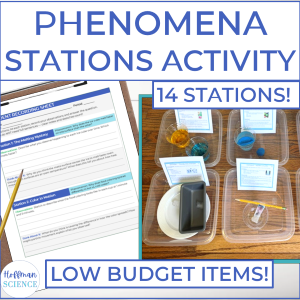
If you'd like to try phenomena stations but don't want to spend hours gathering ideas and creating materials, I've put together a 14-station Phenomena Stations Activity for middle school science that supports NGSS* teaching.
The stations include Life Science, Earth and Space Science, and Physical Science phenomena, making them easy to use throughout the school year.
You'll find:
✔️ Station cards
✔️ Student recording sheets
✔️ A differentiated version with sentence frames and word banks
✔️ Teacher answer keys
✔️ Easy-to-find materials
You can use all 14 stations (over many days) or simply choose the ones that fit your curriculum.
Teachers can use them during the first week of school or as unit introductions.
Why It Matters
At the end of the day, science is about curiosity.
When students observe something surprising and immediately start asking questions, we've already won half the battle.
Phenomena help students connect science to the real world, think critically, and develop explanations based on evidence.
It's a way of understanding the world around them.
If you're new to phenomena-based teaching, start small. Try one station. One demonstration. One "Why did that happen?" moment.
You might be surprised by how quickly your students start doing what scientists do best: asking questions.